
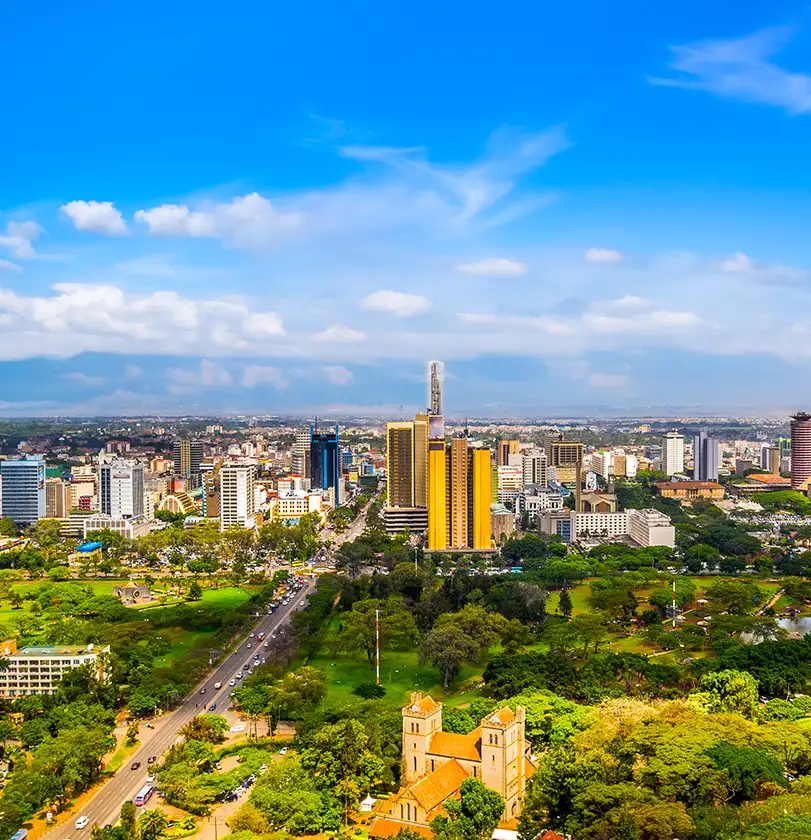
Nairobi represents the whole nature of colonialism: the transfer, or theft, of wealth from what we now call the Global South to the West. Far from a thing of the past, since the capitalist system could only sustain its “infinite” production through the accumulation of labour and resources from the colonies, the independent countries that were once protectorates now face similar extraction, imposed not through armies and colonial bureaucracies but through monetary institutions and global banking, the IMF and the World Bank chief among them. One of the clearest cases of this is Kenya, the second most indebted country to the IMF in Africa, and the site of the first Gen Z protests against the corrupt elites accused of ransacking the country’s wealth to further feed the greed of the Global North.
The trap is set. No matter how rich or productive a nation may be these nations cannot grow and create their own wealth, because the system in which they operate is built to extract it. Another name for this economic plunder is dependence. The alternative is a different economic model, one that fosters independence and self-reliance rather than dependency on outside investors.
I don’t claim to have the panacea to this problem, or to have found this alternative model. But I can say that on a much smaller scale, an intra-state scale, I’ve glimpsed what it might look like. The case study is the slums of Mathare and Dandora, in Nairobi.
These slums have their origins in colonial law, under which the local African population was barred from the city of Nairobi and required a work permit to enter and serve their white colonial employers. Nairobi was conceived as a “white city,” which meant the African population that worked there had to settle on its outskirts. These settlements, never part of the original urban plan, were also never connected to electricity grids, sewer systems, or water pipes. This is how entrenched poverty and systemic inequality took root in Nairobi: the Black population forced to work for a pittance in the city centre and Westlands, and forced out at the end of each day to informal settlements still lacking, to this day, any form of public services.
In Mathare now, the same problems persist. No running water, no electricity, no sewage. The Mathare River, once a source of fresh water for the settlement’s residents, is now so polluted upstream that it’s little more than a dumping ground, lined with heaps of plastic burning on its shore and bubbling a yellow foam. Residents now depend on the Nairobi Water Company, which sells them water at roughly five times the price charged in the city’s wealthier districts.
As in Mathare, so in Dandora and Kibera: most residents work elsewhere in the city, hustling, selling counterfeit football jerseys, or cleaning expatriates’ houses once a week. The colonial-era model persists. Black Nairobi works in the city for the benefit of the wealthy, and lives on the margins, forgotten in the settlements it built.
I saw this while conducting a research fellowship in Mathare on state demolitions as a form of state violence, a separate story, though intrinsically linked to this one. What I also learned during that time was of a genuinely novel initiative underway to build circular, ecological, locally owned economies not dependent on outside loans. Economies held entirely within the community, and at the service of the community, rather than some investor in an eighth-floor office downtown.
The first experiment of this kind grew out of the waste-picking economy. Waste picking is exactly what it sounds like: an army of men, women, and children walking the settlement, collecting bottles, cans, containers, plastics, and fabrics, hauling them by the sack to processing sites, which sort the material and resell it again to recyclers who turn it into fresh bottles or plastic goods. Waste pickers sit at the bottom of that chain, moving through the city like bottom-feeders, their labour invisible, cleaning up after everyone else while capturing almost none of the value they create. They sell the raw value of the trash, often at a loss relative to the labour it took to collect, while everyone further up the chain sells a finished product.
In Mathare, that arrangement has started to change. Two years ago, a group of residents began organizing pickers into a union, working with the Mathare Social Justice Centre. Njeri, the union’s chair, explained the logic to me plainly: without organizing, there’s no way to hold a political position at all. Most of Mathare has no formal jobs. People get by however they can, hustling means improvising daily, women disproportionately through domestic work, men and youth increasingly through waste picking. Organizing pickers wasn’t only an economic project. It also let the union take up the ecological collapse of the settlement itself, a crisis the informal economy cleans up daily, and is paid almost nothing for.
Two years on, the union counts around a hundred members: two registered women’s groups and four youth groups. The womens is the most consistent since the cooperative is of ‘waste pickers and domestic workers’. Women often doubling down as both in Mathare.Membership splits roughly sixty-forty toward women, though that shifts. Njeri says women’s participation tends to be steadier, and that loans to women are easier to track and recover than loans to men, where drug use in the settlement complicates repayment.
The women’s branch runs on a solidarity fund the members built themselves: 3,000 shillings to start, grown to 200,000 in a year and a half, entirely through member savings and voluntary contribution. No outside money went into it. It has since paid for something that reads as almost incidental next to the figures: a women-only park, a safe space the union built on its own initiative, because it finally had the independence to do so.
The cooperative guards its own boundaries deliberately. Membership isn’t open. It runs through people the union already knows, from the same streets and the same class, specifically so the fund can’t be captured by outside money. A cooperative sitting on real capital is a target, and the union has built its admission process around keeping that capital in the hands of the people who built it.
The cooperative’s finances run through a bank the union controls itself. Loans are decided collectively, at a members’ meeting held once a month, one person one vote, no absentee voting. A government representative sits in on these meetings too, a form of oversight the union tolerates rather than invited, Njeri told me, without elaborating on what that oversight has actually meant in practice. Leadership runs through an elected structure, a chair, vice chair, and treasurer, alongside a separate conflict resolution committee and an oversight committee with its own officers.
What organizing bought pickers is concrete. Before the union, most had no protective equipment at all; they now have PPE, gloves to boots, funded through the cooperative. Women had no health coverage; they do now. And the union renegotiated the one relationship that had always set the terms of their labour: the price middlemen paid for their trash. Brokers used to buy plastic off pickers at three to five shillings a kilo while reselling it at 10 to 15, pocketing roughly half the value pickers had generated with their own labour. The union has since signed a six-month contract with a buyer, Mr. Green, cutting the broker out entirely: 15 shillings a kilo for standard plastic, 40 for hard plastic. The union now moves about two tonnes of recyclables a week under that arrangement, material that would otherwise have gone straight into Dandora, the dumpsite the wider MSJC project is trying to shrink.
None of this is a mass movement yet, and Njeri doesn’t pretend otherwise. A hundred members is roughly two percent of Mathare’s waste pickers, in a settlement where almost nobody chooses waste picking; it’s what’s left once everything else has failed. The claim the union makes is that a cooperative model can work within the hustle economy, and that a last-resort trade doesn’t have to stay a degrading one.
In fact they acknowledge the interconnectedness of many of the settlements problem and contribute to fixing them. Acute water scarcity and increased prices of water have forced many people to use the polluted river for washing, cooking and even drinking. Leading to a public health crisis. The Waste pickers and domestic workers cooperative has therefore invested in a community lead initiative from the Mathare Social Justice Center to filter and chemically treat water from the river. Project Alizeti, which is scheduled to be operative by the end of the year.
Another issue the cooperative continues to participate in is the occupation of riparian land after the illegal demolitions by the state and the 2024 droughts. Here they have built community parks, and a womens only park, where kids can play, adults can socialise comfortably and community crops have been planted, This is also the space where they canhold cooperative education sessions every Friday at 9:00 a.m. for our membership. Alleviating, as much as possible hunger in Mathare.
It would be a mistake to read this as a finished model, or to pretend that a hundred people renegotiating their own terms of trade undoes what colonial urban planning and decades of structural adjustment built into Nairobi’s geography.
But the reversal itself is significant. Value that used to leave Mathare in a broker’s pocket now stays inside a the community that a hundred waste pickers. The cooperative represents a small, working instance of locally owned circular economy: proof, at the scale of a single settlement, that the alternative to dependency doesn’t have to wait on a different IMF. It can be built, slowly and unevenly, by the people currently sitting at the bottom of the chain.

Leave a Reply